

24/08/2025
PCE High-Range Water Reducing admixtures (HWR), are essential in modern concrete technology. They allow for significant water reduction while maintaining or improving workability, resulting in concrete with enhanced strength, durability, and long-term performance. However, the effectiveness of PCE admixtures is influenced by several key factors that professionals must understand to achieve optimal results.
In this article, we explore the 7 key factors affecting PCE High-Range Water Reducing in concrete—from cement properties to dosage and application methods—along with best practices for maximizing efficiency.
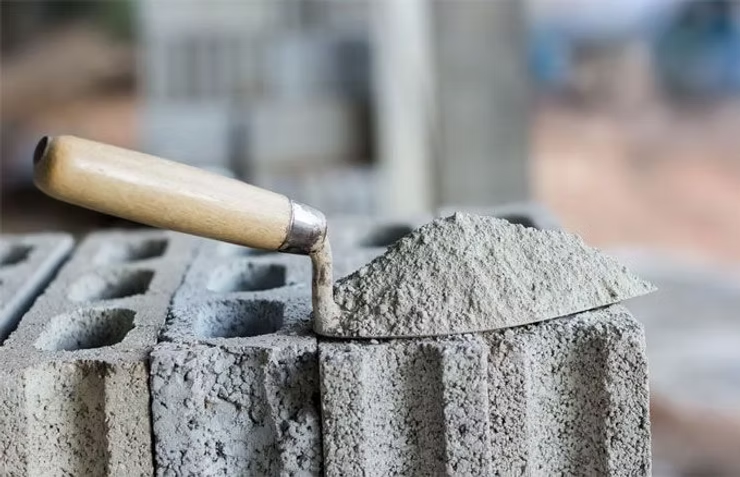
Cement Properties and Their Role in PCE High-Range Water Reducing
The properties of cement significantly affect HWR performance. Variations in cement type alter compatibility, with the clinker’s mineral composition which impacting dispersion. The form of gypsum, used as a setting regulator (e.g., dihydrate, hemihydrate, or anhydrite), influences hydration rates; hemihydrate may accelerate setting, affecting slump retention. Cement fineness also matters—finer particles demand more HWR due to increased surface area. The presence of supplementary cementitious materials (SCMs) like fly ash or slag, cement freshness, moisture content, and temperature (e.g., above 60°C accelerating hydration or below 5°C slowing it) further impact HWR efficacy.
The Importance of Water-to-Cement Ratio
One of the primary goals of using PCE High-Range Water Reducing admixtures is to lower the water-to-cement (w/c) ratio without compromising workability. By achieving lower w/c ratios, concrete develops higher compressive strength and better long-term durability. However, overdosing can lead to segregation or delayed setting times. Balancing dosage with the target w/c ratio is crucial for consistent performance.
Dosage Optimization for Strength and Workability
The dosage of PCE High-Range Water Reducing admixtures varies depending on cement type, mix design, and required performance. Typically, dosage ranges between 0.2%–1.5% by weight of cement. Underdosing may result in poor slump retention, while overdosing can cause excessive bleeding or extended setting times.
Conducting trial mixes is the best way to identify the optimal dosage. For example, in ready-mix operations where workability retention is critical, a slightly higher dosage may be applied, while precast operations may prioritize early strength development with more precise dosage control.
Application Methods and Environmental Factors
Beyond cement properties and dosage, the application method of PCE HRWR plays a significant role. The timing of admixture addition—whether directly to fresh cement paste, into the mixing water, or after partial hydration—affects its dispersing performance.
Environmental factors such as temperature and humidity also impact results. High ambient temperatures accelerate hydration, reducing workability retention, while cold climates may slow down the reaction, delaying setting. Engineers must adjust admixture selection and dosage to suit local site conditions.
Mixing and Placement Conditions
The efficiency of PCE admixtures is also affected by mixing sequence, speed, and duration. Adding the admixture too early may reduce its effectiveness due to premature adsorption, while delayed addition can optimize dispersion. Temperature and humidity during mixing and placement also play a role, as higher temperatures tend to accelerate slump loss.
Supplementary Cementitious Materials (SCMs)
Modern concrete mixes often incorporate fly ash, silica fume, slag, or other SCMs to improve sustainability and performance. These materials interact differently with PCE High-Range Water Reducing admixtures. For instance, fly ash can enhance slump retention, while silica fume may increase water demand. Understanding these interactions helps ensure consistent quality in concrete production.
Desired Performance Requirements
The final effectiveness of PCE admixtures must always be evaluated against the project’s specific performance needs. High-strength applications, self-consolidating concrete (SCC), or precast elements each demand a tailored admixture strategy. Factors like setting time, early strength gain, shrinkage control, and durability all need to be balanced during dosage design.
Practical Recommendations
To fully unlock the benefits of PCE High-Range Water Reducing admixtures, professionals should follow these best practices:
-
Always test compatibility between cement and admixture before large-scale use.
-
Adjust dosage based on environmental conditions and mix design.
-
Use trial batches to fine-tune workability and setting time.
-
Incorporate SCMs strategically for enhanced durability and sustainability.
-
Train on-site teams to handle admixture addition correctly for consistent results.
By applying these practices, concrete producers and engineers can achieve superior performance, reduced material costs, and improved long-term durability of structures.
The effectiveness of PCE High-Range Water Reducing admixtures is influenced by a combination of material properties, environmental conditions, and mix design strategies. By understanding and managing these factors—cement composition, water quality, admixture dosage, aggregates, SCMs, and project-specific requirements—professionals can maximize the benefits of PCE admixtures. This ensures not only better workability and strength but also greater durability and sustainability in modern concrete construction.
For further technical guidelines, refer to the American Concrete Institute (ACI). To explore more insights on admixture technology, check our article on Optimizing High-Range Water Reducer Dosage.


